
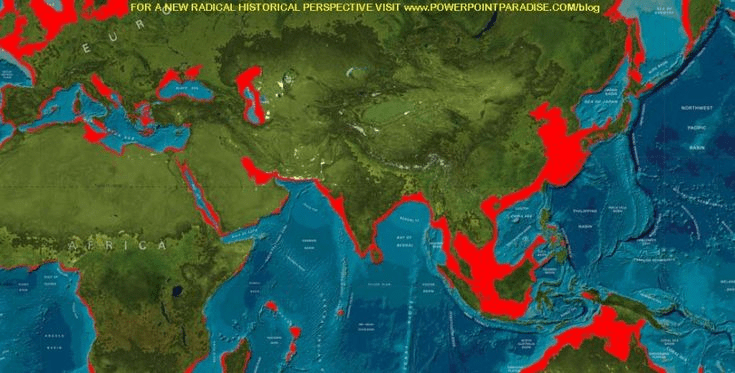
Bharata Varsha, The Island
Along with the 7 continents, the eighth continent, Anant (Antarctica), has also been described in the Puranas. Their names are:
- Jambu Island (Asia) also known as Jambudvipa
- Plaksa Island (Europe)
- Kush Island (Africa North of the Equinox)
- Shalmali Island (Africa South of the Equinox)
- Shaka or Agni Island (Australia)
- Kraunch Island (North America)
- Pushkar Island (South America)
Island here does not mean that they are surrounded by the sea in every direction, it can also be sea, mountain, desert or other natural boundary. The names of the islands on Earth and the annular regions formed by the revolution of the planets around the Earth in the solar system are also like the islands of the Earth.
The parts between them have also been named the oceans of the Earth. Similarly, the central ring of the universe has also been called a galaxy, although it is not a river like the Ganga. Even in the modern era, celestial creations are named in the same manner.
The islands and oceans of the solar system are circular or ring-shaped, whereas the islands of the Earth are irregularly shaped. The Pushkar island of the solar system is a ring formed by the orbit of Uranus, whose thickness is 16 crore yojanas, which obviously cannot be on Earth, which is 1000 yojanas in diameter.
After the Mahabharata, the people who compiled the Puranas had no contact with Australia and America, nor were they measuring the solar system. All measurements are from the pre-Mahabharata period.
Nationality of India
One of the four parts of the map of the northern hemisphere. These are referred to as the four divisions of Bhupadam.(Vishnu Purana, 2/2/24,40).
Here, the meaning of the Bharat division is from the equator to the North Pole,
45 degrees east-west of Ujjain.
Similarly, Ketumal is to the west,
Bhadrashva to the east,
and in the opposite direction (north), Kurukshetra is at 90-90 degrees longitude.
This Bharat division was called the realm of Indra.
In the middle was China, which people still call the central state. There, Brihaspati gave different symbols for each word, which was called “Shabda Parayana”. No one could learn more than 15,000 characters, so Indra and the Maruts divided the words into 49 original divisions and organized them according to the pronunciation sequence.
The Chinese stuck to their method. The methods of India and Russia became one. Even today, most of the words in the Russian language have the same meaning as Vedic words.
Bharat Varsha
After extending the Himalayas to the east-west sea, its part till the southern sea is called Bharat Varsha which is of 9 parts.
अत्र ते कीर्तयिष्यामि वर्षं भारत भारतम्। प्रियमिन्द्रस्य देवस्य मनोर्वैवस्वतस्य च॥५॥
Here, I will tell you about the Bharat Varsha (India). It was dear to Indra the god, Manu, and Vaivasvata.
पृथोस्तु राजन् वैन्यस्य तथेक्ष्वाकोर्महात्मनः। ययातेरम्बरीषस्य मान्धातुर्नहुषस्य च॥६॥
King Pritha was the son of Vainya and so was the great Ikshvaku of Yayati, Ambarisha, Mandhata and Nahusha.
तथैव मुचुकुन्दस्य शिवेरौशीनरस्य च। ऋषभस्य तथैलस्य नृगस्य नृपतेस्तथा॥७॥
Similarly, of Muchukunda, the son of Shivi, and of Ushinara, and also of Rishabha, the son of Ajamidha, and of Nriga, the royal sage.” (Bhagavata Purana 9.22.7)
कुशिकस्य च दुर्द्धर्ष गाधेश्चैव महात्मनः। सोमकस्य च दुर्द्धर्ष दिलीपस्य तथैव च॥८॥
The invincible Kusika and the great Gadhi Somaka and also the invincible Dilipa.
अन्येषां च महाराज क्षत्रियाणां बलीयसाम्। सर्वेषामेव राजेन्द्र प्रियं भारत भारतम्॥९॥
Amongst other mighty Kshatriyas, All Kings favourite land is Bharata (India)
अथाहं वर्णयिष्यामि वर्षेऽस्मिन् भारते प्रजाः। भरणच्च प्रजानां वै मनुर्भरत उच्यते॥५॥
निरुक्तवचनाच्चैव वर्षं तद् भारतं स्मृतम्। यतः स्वर्गश्च मोक्षश्च मध्यमश्चापि हि स्मृतः॥६॥
भारतस्यास्य वर्षस्य नव भेदान् निबोधत॥७॥
इन्द्रद्वीपः कशेरुश्च ताम्रपर्णो गभस्तिमान्। नागद्वीपस्तथा सौम्यो गन्धर्वस्त्वथ वारुणः॥८॥
अयं तु नवमस्तेषां द्वीपः सागर संवृतः। योजनानां सहस्रं तु द्वीपोऽयं दक्षिणोत्तरः॥९॥
आयतस्तु कुमारीतो गङायाः प्रवहावधिः। तिर्यगूर्ध्वं तु विस्तीर्णः सहस्राणि दशैव तु॥१०॥
यस्त्वयं मानवो द्वीपस्तिर्यग् यामः प्रकीर्तितः। य एनं जयते कृत्स्नं स सम्राडिति कीर्तितः॥१५॥
(Now I shall describe the people who inhabit this land of Bharat. It is dear to Indra, the god Manu and Vaivasvata.) (Verse 5)
According to Nirukta, this land is called Bharatavarsha. This is because this region is the medium for liberation and salvation. (Verse 6)
Understand the nine divisions of the land of Bharat. (Verse 7)
The nine divisions are: Indradvipa, Kaseru, Tamraparna, Gabhastiman, Nagadvipa, Saumya, Gandharvasth, and Varuna. (Verse 8)
Indradvipa = Southeast Asia, where 50 Vedic words related to Indra are still in use today. The eagle is also named after the Waintey district of Cambodia.
Kaseru = Borneo, Celebes, Philippines.
Tamraparna = Sinhala (Sri Lanka) near Tamil Nadu.
Gabhastiman = Eastern Indonesia. Papua New Guinea was also a part of Australia, where the Gabhasti River is said to be in Shaka Island.
Nagdweep = Andaman Nicobar to Western Indonesia. Nag also means elephant. Due to being in the shape of an elephant’s trunk, the west-east parts of Indonesia are called Big and Small Trunks.
Soumya = Tibet in the north.
Gandharvastha = Afghanistan, Iran.
Varun = Arab, Iraq.
This (Akhand Bharat) is the Kumarika, or Bharat Varsh, which has been widening from the South Sea to the source of the Ganga.
Kumarika Khanda
This is mostly about India as it exists today. Viewed from the south, it forms a downward triangle, hence, it’s referred to as the triangle of Shakti according to tantric beliefs. The essence of power is Kumari, hence, due to being central to the nine divisions of India, it’s called Kumari. Named after Rishabh’s son Bharat, it’s called Bharat. Also known as Bharat due to its role in sustaining people or the world through food.
to be continued…part 2
