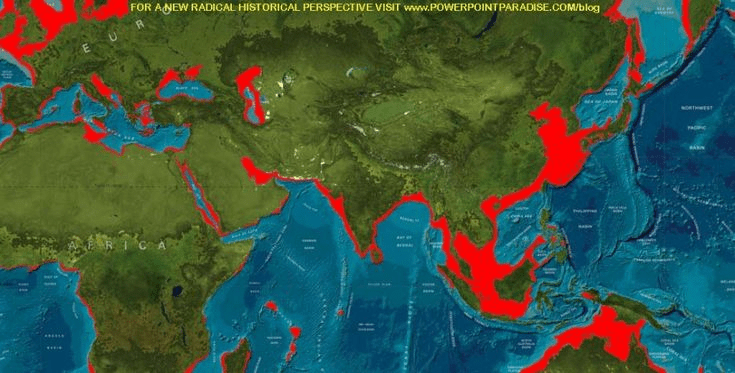
Why did our ancestors call the Indian subcontinent as Jambudweepa?
Jambudvipa (Sanskrit: जम्बुद्वीप; Pali: Jambudīpa) is the dvīpa (“island” or “landmass”) of the earthbound world, as imagined in the cosmologies of Hinduism, Buddhism, and Jainism, which is the domain where common individuals reside.

As per Dharmic sacred texts, the earth has seven ‘dwipas’ (islands or landmasses). These seven mainlands are called Jambu dwipa, Plaksha dweepa, Shalmali dweepa, Kusha dweepa, Krauncha dweepa, Shaka dweepa, and Pushkara dweepa. Jambudvipa is focus north of the globe. In the event that the earth was a body, Jambudvipa would be set some place close to the heart. Which is what I assume the focal point of the earth represents.
Jambu is the name of the rose apple tree which is local to this mainland and is probably the most seasoned tree referenced in the Puranas.It is additionally said that the seven dwipas are expanses of land on the earth, yet have a lot further layered clarification.
As indicated by Puranic cosmography, the world is partitioned into seven concentric island mainlands (sapta-dvipa vasumati) isolated by the seven surrounding seas, each twofold the size of the previous one (going out from the inside). The seven landmasses of the Puranas are expressed as Jambudvipa, Plaksadvipa, Salmalidvipa, Kusadvipa, Krouncadvipa, Sakadvipa, and Pushkaradvipa. Seven moderate seas comprise of salt-water, sugarcane juice, wine, ghee, yogurt, milk and water respectively.[4][5] The mountain range referred to Lokaloka, significance as “world-no-world”, extends across this last ocean, depicting the well explored regions of the planet from the dead space.

Continent Jambudvipa (Indian Blackberry Island), also known as Sudarshanadvipa, forms the innermost concentric island in the above scheme. Its name is said to derive from a Jambu tree (another name for the Indian Blackberry). The fruits of the Jambu tree are said, in the Viṣṇupurāṇa (ch.2) to be as large as elephants and when they become rotten and fall upon the crest of the mountains, a river of juice is formed from their expressed juice. The river so formed is called Jambunadi (Jambu river) and flows through Jambudvipa, whose inhabitants drink its waters. Insular continent Jambudvipa is said to comprise nine varshas (zones) and eight significant parvatas (mountains).
Markandeya Purana portrays Jambudvipa as being depressed on its south and north and elevated and broad in the middle. The elevated region forms the varsha named Ila-vrta or Meruvarsha. At the center of Ila-vrta lies the golden Mount Meru, the king of mountains. On the summit of Mount Meru, is the vast city of Lord Brahma, known as Brahmapuri. Surrounding Brahmapuri are 8 cities – the one of Lord Indra and of seven other Devatas.

Description of the earth. The seven Dvīpas and seven seas. Jambudvipa . Mount Meru: its extent and boundaries. Extent of Ilāvrita. Groves, lakes, and branches of Meru. Cities of the gods. Rivers. The forms of Viṣṇu worshiped in different Varṣas. All of these are given in Vishnu Purana.
Maitreya said, “You have related to me, Brahman, the creation of Svāyambhuva; I am now desirous to hear from you a description of the earth: how many are its oceans and islands, its kingdoms and its mountains, its forests and rivers and the cities of the gods, its dimensions, its contents, its nature, and its form.”
Here, Sage Maitreya asked Sage Parashara about the creation and the features of this world. Sage Parashara gives a description of Jambudvipa.

Parāśara said, “You shall hear, Maitreya, a brief account of the earth from me: a full detail I could not give you in a century.
The seven great insular continents are Jambu, Plakṣa, Sālmali, Kuśa, Krauncha, Śāka, and Puṣkara: and they are surrounded severally by seven great seas; the sea of salt water (Lavaṇa), of sugar-cane juice (Ikṣu), of wine (Surā), of clarified butter (Sarpi), of curds (Dadhi), of milk (Dugdha), and of fresh water (Jala)
Jambu-dvīpa is in the center of all these: and in the center of this continent is the golden mountain Meru. The height of Meru is eighty-four thousand Yojanas; and its depth below the surface of the earth is sixteen thousand. Its diameter at the summit is thirty-two thousand Yojanas; and at its base, sixteen thousand: so that this mountain is like the seed-cup of the lotus of the earth.
The boundary mountains (of the earth) are Himavān, Hemakūṭa, and Niṣadha, which lie south of Meru; and Nīla, Śveta, and Śriṅgī, which are situated to the north of it. The two central ranges (those next to Meru, or Niṣadha and Nīla) extend for a hundred thousand (Yojanas, running east and west). Each of the others diminishes ten thousand Yojanas, as it lies more remote from the center. They are two thousand Yojanas in height, and as many in breadth[3]. The Varṣas or countries between these ranges are Bhārata (India), south of the Himavān mountains; next Kimpuruṣa, between Himavān and Hemakūṭa; north of the latter, and south of Niṣadha, is Hariversha; north of Meru is Ramyaka, extending from the Nīla or blue mountains to the Śveta (or white) mountains; Hiraṇmaya lies between the Śveta and Śriṅgī ranges; and Uttarakuru is beyond the latter, following the same direction as Bhārata[4]. Each of these is nine thousand Yojanas in extent. Ilāvrita is of similar dimensions, but in the center of it is the golden mountain Meru, and the country extends nine thousand Yojanas in each direction from the four sides of the mountain[5]. There are four mountains in this Varṣa, formed as buttresses to Meru, each ten thousand Yojanas in elevation: that on the east is called Mandara; that on the south, Gandhamādana; that on the west, Vipula; and that on the north, Supārśva[6]: on each of these stands severally a Kadamba-tree, a Jambu-tree, a Pīpal, and a Vaṭa[7]; each spreading over eleven hundred Yojanas, and towering aloft like banners on the mountains. From the Jambu-tree the insular continent Jambu-dvīpa derives its appellations. The apples of that tree are as large as elephants: when they are rotten, they fall upon the crest of the mountain, and from their expressed juice is formed the Jambu river, the waters of which are drunk by the inhabitants; and in consequence of drinking of that stream, they pass their days in content and health, being subject neither to perspiration, to foul odors, to decrepitude, nor organic decay. The soil on the banks of the river, absorbing the Jambu juice, and being dried by gentle breezes, becomes the gold termed Jāmbunada, of which the ornaments of the Siddhas are fabricated.
The country of Bhadrāśva lies on the east of Meru, and Ketumāla on the west; and between these two is the region of Ilāvrita. On the east of the same is the forest Chitraratha; the Gandhamādana wood is on the south; the forest of Vaibhrāja is on the west; and the grove of Indra, or Nandana, is on the north. There are also four great lakes, the waters of which are partaken of by the gods, called Aruṇoda, Mahābhadra, Śītoda, and Maṇasa[8].
The principal mountain ridges which project from the base of Meru, like filaments from the root of the lotus, are, on the east, Śītānta, Mukunda, Kurarī, Mālyavān, and Vaikanka; on the south, Trikūṭa, Śiśira, Patanga, Rucaka, and Niṣadha; on the west, Śikhivāsas, Vaidūrya, Kapila, Gandhamādana, and Jārudhi; and on the north, Śaṅkhakūṭa, Riṣabha, Nāga, Hansa, and Kālañjara. These and others extend from between the intervals in the body, or from the heart, of Meru[9].
On the summit of Meru is the vast city of Brahmā, extending fourteen thousand leagues, and renowned in heaven; and around it, in the cardinal points and the intermediate quarters, are situated the stately cities of Indra and the other regents of the spheres[10]. The capital of Brahmā is enclosed by the river Ganges, which, issuing from the foot of Viṣṇu, and washing the lunar orb, falls here from the skies[11], and, after encircling the city, divides into four mighty rivers, flowing in opposite directions. These rivers are the Śītā, the Alakanandā, the Cakṣu, and the Bhadrā. The first, falling upon the tops of the inferior mountains, on the east side of Meru, flows over their crests, and passes through the country of Bhadrāśva to the ocean: the Alakanandā flows south, to the country of Bhārata, and, dividing into seven rivers on the way, falls into the sea: the Cakṣu falls into the sea, after traversing all the western mountains, and passing through the country of Ketumāla: and the Bhadrā washes the country of the Uttara kurus, and empties itself into the northern ocean
Meru, then, is confined between the mountains Nīla and Niṣadha (on the north and south), and between Mālyavān and Gandhamādana (on the west and east[13]): it lies between them like the pericarp of a lotus. The countries of Bhārata, Ketumāla, Bhadrāśva, and Uttarakuru lie, like leaves of the lotus of the world, exterior to the boundary mountains. Jaṭhara and Devakūṭa are two mountain ranges, running north and south, and connecting the two chains of Niṣadha and Nīla. Gandhamādana and Kailāsa extend, east and west, eighty Yojanas in breadth, from sea to sea. Niṣadha and Pāriyātra are the limitative mountains on the west, stretching, like those on the east, between the Nīla and Niṣadha ranges: and the mountains Triśriṅga and Jārudhi are the northern limits of Meru, extending, east and west, between the two seas[14]. Thus I have repeated to you the mountains described by great sages as the boundary mountains, situated in pairs, on each of the four sides of Meru. Those also, which have been mentioned as the filament mountains (or spurs), Śītānta and the rest, are exceedingly delightful. The valleys embosomed amongst them are the favorite resorts of the Siddhas and Cāraṇas: and there are situated upon them agreeable forests, and pleasant cities, embellished with the palaces of Viṣṇu, Lakṣmī, Agni, Sūrya, and other deities, and peopled by celestial spirits; whilst the Yakṣas, Rākṣasas, Daityas, and Dānavas pursue their pastimes in the vales. These, in short, are the regions of Paradise, or Svarga, the seats of the righteous, and where the wicked do not arrive even after a hundred births.
In the country of Bhadrāśva, Viṣṇu resides as Hayasīrā (the horse-headed); in Ketumāla, as Varāha (the boar); in Bhārata, as the tortoise (Kūrma); in Kuru, as the fish (Matsya); in his universal form, every where; for Hari pervades all places: he, Maitreya, is the supporter of all things; he is all things. In the eight realms of Kimpuruṣa and the rest (or all exclusive of Bhārata) there is no sorrow, nor weariness, nor anxiety, nor hunger, nor apprehension; their inhabitants are exempt from all infirmity and pain, and live in uninterrupted enjoyment for ten or twelve thousand years. Indra never sends rain upon them, for the earth abounds with water. In those places there is no distinction of Krita, Treta, or any succession of ages. In each of these Varṣas there are respectively seven principal ranges of mountains, from which, oh best of Brahmans, hundreds of rivers take their rise[15].

Map according to Sri Rai Krishna Dasa

Source : Vishnu Purana, Book II, Chapter II – Description of the earth (the seven Dvipas and seven seas).
Om Namah Shivaya