

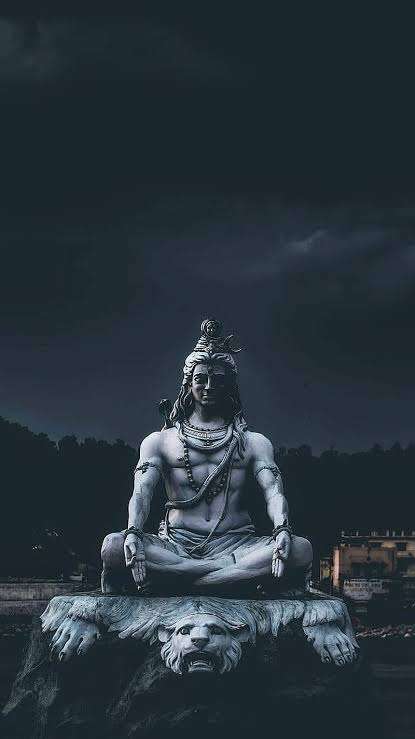
In the rich tapestry of Hindu mythology, one deity stands as the quintessential source of all creation—Lord Shiva. According to ancient scriptures, it is from the very essence of Lord Shiva that the cosmos, along with Brahma and Vishnu, finds its origins.
The MythologY
To succinctly encapsulate this enthralling narrative, we journey back to a time when the previous creation met its end. From the navel of Lord Narayana emerged a resplendent lotus, a harbinger of a new era. It was upon this lotus that Brahma, the architect of life, made his grand entrance. Descending gracefully on a lotus stalk, Brahma embarked on a quest to unveil the genesis of his creation. Here, amidst the cosmic ether, he found Lord Narayana, deeply immersed in a yogic slumber. Awakening the deity, Brahma posed a fundamental question, “Who are you?” In response, Narayana revealed, “I am the Supreme Purusha, the very genesis and dissolution of all realms.” Undeterred, Brahma asserted his role as the progenitor of the universe. It was at this pivotal moment that Lord Vishnu intervened, orchestrating a revelation that showcased the entire cosmos encapsulated within Brahma himself. A profound realization dawned upon Brahma, and he declared, “This suggests that both you and I are creators of the universe.” Vishnu, in gentle correction, conveyed that Brahma was missing a crucial piece of the cosmic puzzle—Lord Shiva, the supreme force and ultimate origin of all existence. The key to understanding lay in the yogic vision, as Lord Sadashiva, the wellspring of all life, would soon unveil Himself.
With unwavering determination, Brahma employed his yogic gaze and beheld a divine form adorned with a trident, radiating an ethereal cerulean complexion. Curious, he turned to Narayana and inquired, “Who is this?” Narayana’s reply left Brahma in awe, “This is none other than the divine Lord Mahadeva—the one who not only begets and sustains but also ultimately absorbs all living beings. His existence transcends the constraints of time and space, encompassing the entirety of the cosmos.” Thanks to Lord Vishnu’s benevolence, Brahma bore witness to the majestic visage of Lord Sadashiva.
The Divine Family and Abode of Lord Shiva
Lord Shiva reigns over a vast divine family, including eleven Rudranis, sixty-four Yoginis, and Bhairava, among others. Mata Parvati’s circle boasts notable associates like Vijaya, while Ganapati’s consorts are Siddhi and Buddhi, with their sons, Kshem and Labh. An intriguing element of Lord Shiva’s persona is His choice of a mouse as His mode of transportation.
Meanwhile, Lord Kartikeya embarks on his adventures alongside his wife, Devsena, riding upon a magnificent peacock. Goddess Parvati, a formidable deity herself, finds her mount in a majestic lion, while Lord Shiva faithfully commutes atop His trusted holy vehicle, Nandi.
Sacred Abodes and Benevolence
Lord Shiva’s presence is ubiquitous, but Kashi and Kailash stand out as His paramount abodes. Deities from the Hindu pantheon venerate Lord Shiva, who has bestowed immeasurable power and wealth upon numerous entities, including Andhaka, Dundubhi, Mahishasura, Tripura, Ravana, and Nivatakavacha. Through Lord Shiva’s benevolence, Kubera and other Lokapalas ascended to sovereignty over the Yakshas.
A moment of remarkable sacrifice etched Lord Shiva’s legend—when He fearlessly consumed the venom that emerged during the churning of the ocean. This selfless act earned Him the revered epithet “Neelkanth,” symbolizing His indomitable spirit with a blue-throated countenance.
The Infinite Splendor
The splendour and epithets associated with Lord Shiva know no bounds. Uma-Maheshwara, Ardhanarishvara, Pashupati, Krittivasa, Dakshinamurti, and Yogeshwara represent a few among His myriad incarnations.
The Tale of Draupadi
The Mahabharata’s Adi Parva (Book of Beginnings) reveals an intriguing tale of Draupadi, daughter of Panchala ruler Drupada, who was a sage’s progeny in a previous life. In her quest for a virtuous spouse, she embarked on rigorous penance dedicated to Lord Shiva. Pleased with her unwavering devotion, Lord Shiva granted her a boon. Draupadi expressed her desire for a husband possessing all virtues, reiterating this wish five times. Lord Shiva decreed that in her next life, she would be united with five husbands from the Bharata dynasty, aligning with her five-fold request.
The Many Facets of Lord Shiva
Lord Shiva’s multifaceted persona is embodied in numerous titles and forms. The five primary forms of Shiva—Ishana, Tatpurusha, Vamadeva, Aghora, and Adyojata—are complemented by eight illustrious forms, including Sharva, Bhava, Rudra, Ugra, Bhima, Pashupati, Ishana, and Mahadeva.
Sacred Jyotirlingas and Mantras
Among the sacred Jyotirlingas—lingams of divine light—twelve hold special reverence: Somnath, Mallikarjuna, Mahakaleshwar, Omkareshwar, Kedarnath, Bhimashankar, Vishveshwar, Tryambakeshwar, Vaidyanath, Nageshwar, Rameshwaram, and Grishneshwar.
In the veneration of Lord Shiva, two mantras hold profound significance—the Panchakshara Mantra “Namah Shivaya” and the Maha Mrityunjaya Mantra.
Earthly Worship and Legacy
Beyond the realm of myths and legends, Lord Shiva’s earthly embodiment holds a special place in His veneration. Shiva, often regarded as a yogi, is frequently revered through the sacred symbol of the lingam.
The Lord of Creation, Preservation, and Dissolution
Lord Shiva, within the Trinity (Trimurtis), shoulders the mantle of the deity responsible for dissolution. The name “Shiva” signifies not only benevolence and auspiciousness but also the power of dissolution and destruction. Devotees pay their respects to Lord Shiva through the recitation of the Aarti, a soul-stirring devotional song.
Triharini: Cherished Devotees
Among Lord Shiva’s devotees, the Triharini—three daughters of Daksha Prajapati—occupy a special place in His heart, cherished even more dearly than His own sons. These ancient legends paint a vivid and captivating portrait of Lord Shiva, revealing a deity whose mysteries continue to enthrall and inspire generations. As we delve into the realms of Hindu mythology, Lord Shiva remains an enduring enigma, a testament to the profound depths of ancient wisdom and spirituality.
