

Introduction:
The Tropic of Cancer, located at 23 degrees north latitude, holds a secret beyond its geographical significance. It unveils the hidden treasures of sun temples that lie along this line. These awe-inspiring temples in India and Egypt were ingeniously designed to capture the sun’s rays, illuminating the sanctums with a radiant glow. Join us as we explore these remarkable architectural marvels and unravel their ancient wisdom.

Article:
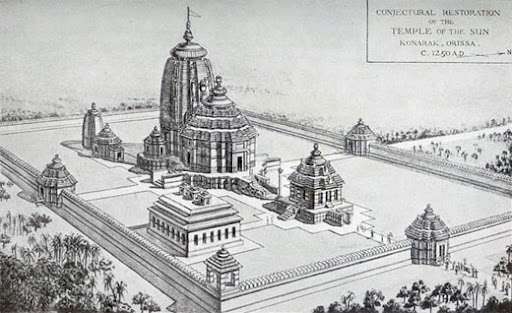
The Tropic of Cancer, stretching along 23 degrees north latitude, reveals a series of magnificent sun temples. James Fergusson’s 1847 sketch of the historic Konark Sun Temple is one of the notable examples. Unfortunately, invaders destroyed the main temple, but its legacy is still present.
In India, the Modhera Sun Temple in Gujarat astounds visitors with its intricate design. During each equinox, the first rays of the rising sun gracefully touch a diamond placed atop the head of the Sun God, enveloping the shrine in a golden hue.

Located at 18.27 degrees north, the Suryanarayanaswamy Temple in Andhra Pradesh stands as a testament to ancient devotion. Journeying further along the Tropic of Cancer, we encounter the Sun Temple at Somnath Patan near Veraval in Gujarat (20.9 degrees), as well as the Sun Temples at Madkheda and Umri near Tikamgadh, Madhya Pradesh (22.9 degrees).
At precisely 23.0 degrees north, the Sun Temple at Kandaha in Bihar enthralls pilgrims with its celestial ambiance. Similarly, the Harsiddhi Temple in Ujjain, situated 23.09 degrees north, captivates visitors with its divine aura.
One cannot overlook the renowned Sun Temple at Modhera in Gujarat, gracefully positioned at 23.5 degrees north. Further along, we discover Kanthad Nath at Kanthkot near Rapar (23.48 degrees), the Sun Temple at Dholavira (23.89 degrees), and the 8th-century Sun Temple in Chittorgarh Fort, which was destroyed in the 14th century and later rebuilt as the Kali Temple (24.59 degrees).
Continuing our journey, we find the Surya Mandir in Deo, Bihar (24.5 degrees), the Dakshinaarka Temple in Gaya (24.7 degrees), the Uttaraka Temple near Uttara Maanas Tank in Gaya (24.7 degrees), and the Gayaditya Temple on the river Falgu in Gaya (24.7 degrees).
The Sun Temple at Jhaira Patan near Kota, Rajasthan, stands as ancient ruins at 25.1 degrees north. Furthermore, the sacred city of Kashi, also known as Varanasi, boasts the Dwadasha Aditya temples, located 25.2 degrees north.
Venturing into Madhya Pradesh, we encounter the Bhramanya Dev Temple at Unao, near Jhansi, positioned at 25.6 degrees north. Heading eastward, we arrive at Sri Surya Pahar, the Sun Temple in Goalpara, Assam (26.0 degrees).
The Sun Temple at Galta near Jaipur, Rajasthan, greets travelers at 26.5 degrees north. In comparison, the Sun Temple in Morar at Gwalior (26.2 degrees) and the Sun Temple at Ranakpur near Udaipur, Rajasthan (27.0 degrees) continue to mesmerize with their grandeur.
Near Almora in Uttarakhand, the Sun Temple occupies a significant spot at 29.37 degrees north, while the Martand Sun Temple in Jammu and Kashmir basks at 32.5 degrees north.
It’s important to realize that the Tropic of Cancer extends beyond India. Egypt boasts remarkable sun temples as well, such as Abu Simbel (22.6 degrees) and Karnak in Luxor (25.43 degrees), showcasing the universal fascination with the sun’s power.
But why were these temples erected along the Tropic of Cancer?
The Tropic of Cancer is the northernmost location the sun reaches during its yearly journey, as we learned in our schoolbooks. In ancient times, the Maha Kaleshwara Temple in Ujjain served as the focal point, much like the Greenwich Observatory is today for the Greenwich Meridian in London.
During special occasions, particularly around the Summer Solstice, our ancestors ingeniously crafted the Sun Temples in India to welcome the sun’s rays into their sanctum sanctorum, illuminating the idols with a celestial radiance. As the month of June arrives and the sun reaches its peak, one cannot help but marvel at the incredible knowledge, wisdom, and architectural skills exhibited by our forefathers in constructing these splendid structures. This custom is a true reflection of India’s cultural legacy and heritage.

Leave a Reply